
The Great Gray Change: How LEGO Rebuilt Its Color Palette in 2004
LEGO has used 193 colors in 77 years. We tracked every one across 1.1 million inventory records: the 2004 peak, the 43% cull, and the legendary Great Gray Change.
Ask LEGO fans about color and the opinions come fast: the lament for the old grays, the hunt for a retired sand green, the relief of a fresh dark turquoise. Color is one of the most emotional topics in the hobby — but almost nobody has put numbers to it.
So we did. We went through the entire BrickMissing catalog — 1,131,058 inventory records across 26,086 sets, from 1949 to 2026 — and tracked all 193 colors LEGO has ever used in its System bricks. The result is a 77-year history of the LEGO palette: the slow climb, the explosion to an all-time peak in 2004, the brutal cull that followed, and the single year LEGO quietly replaced both of its grays.
Key findings
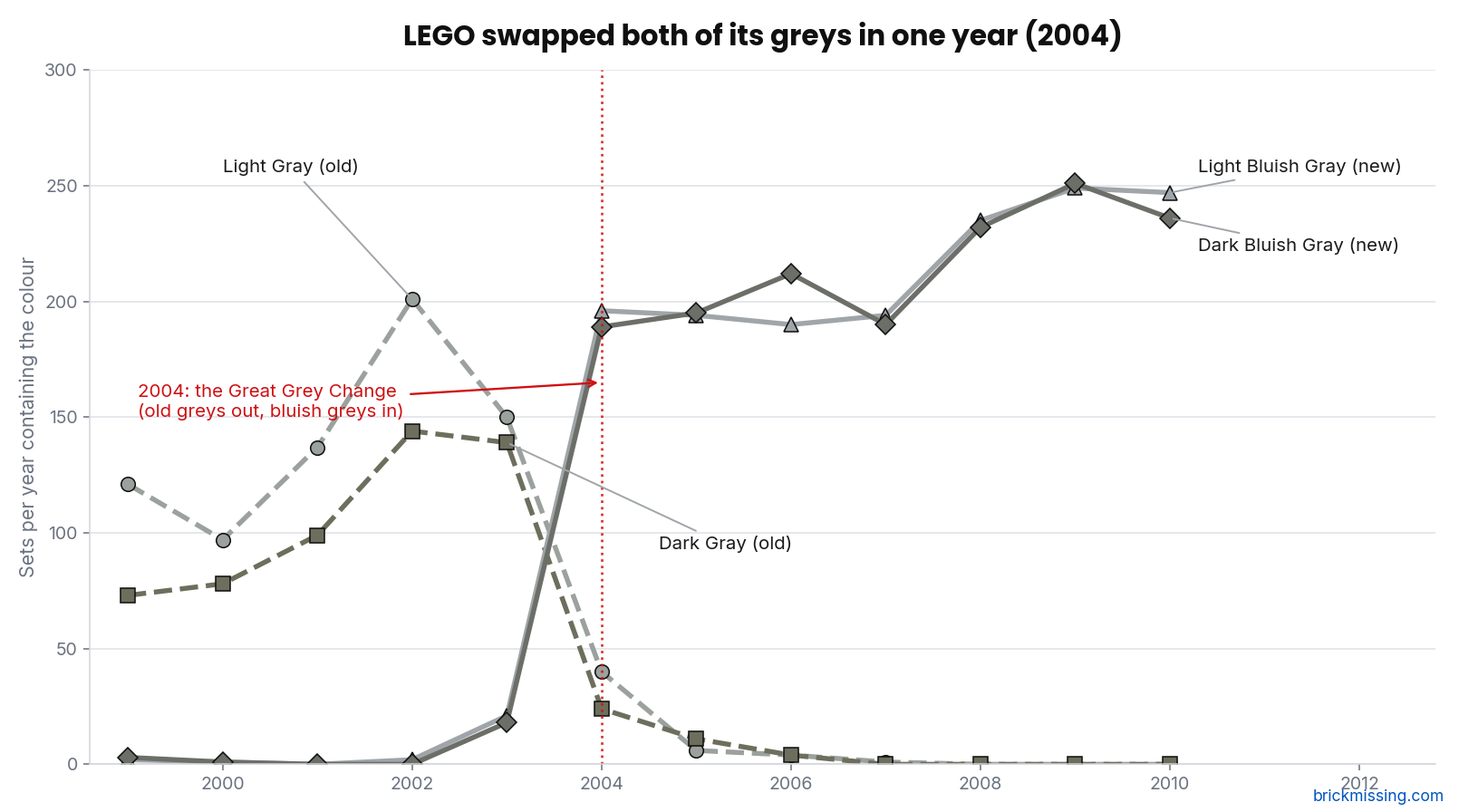
For its first four decades, LEGO's palette grew slowly: a typical year in the early 1990s used around 35 colors. Then it exploded. By 2004 a single year of sets used 108 distinct colors — an all-time record. Just four years later that number had been slashed to 62, a 43% cut, before recovering to around 88 today.
The timing is no accident. This is the same 2000–2004 window our repairability study flagged as the most chaotic in LEGO history — the bespoke-mold spree that pushed the company to the edge of bankruptcy. The crisis is written in the colors as plainly as in the molds: the palette ballooned to a peak in 2004, and the post-bankruptcy rationalization cut it back hard. And in that same year, LEGO replaced both of its grays — the change AFOLs still argue about two decades later.
The explosion and the cliff
LEGO's palette barely moved for forty years, then tripled in a single decade. From 35 colors in 1994 it raced to 72 by 2000 and a record 108 in 2004. The fall was just as steep: by 2008 only 62 colors were in use, a 43% drop in four years. It has climbed back slowly since, to around 88 in 2024 — still well below the 2004 high-water mark.
The peak lines up exactly with the era when LEGO was producing a bespoke mold for every theme — Galidor, Jack Stone, early Bionicle — and nearly went bankrupt doing it. When the company rationalized after 2004, it cut not just molds but colors.
| Year | Colors used |
|---|---|
| 1980 | 17 |
| 1990 | 21 |
| 1994 | 35 |
| 2000 | 72 |
| 2004 (peak) | 108 |
| 2008 | 62 |
| 2015 | 76 |
| 2024 | 88 |
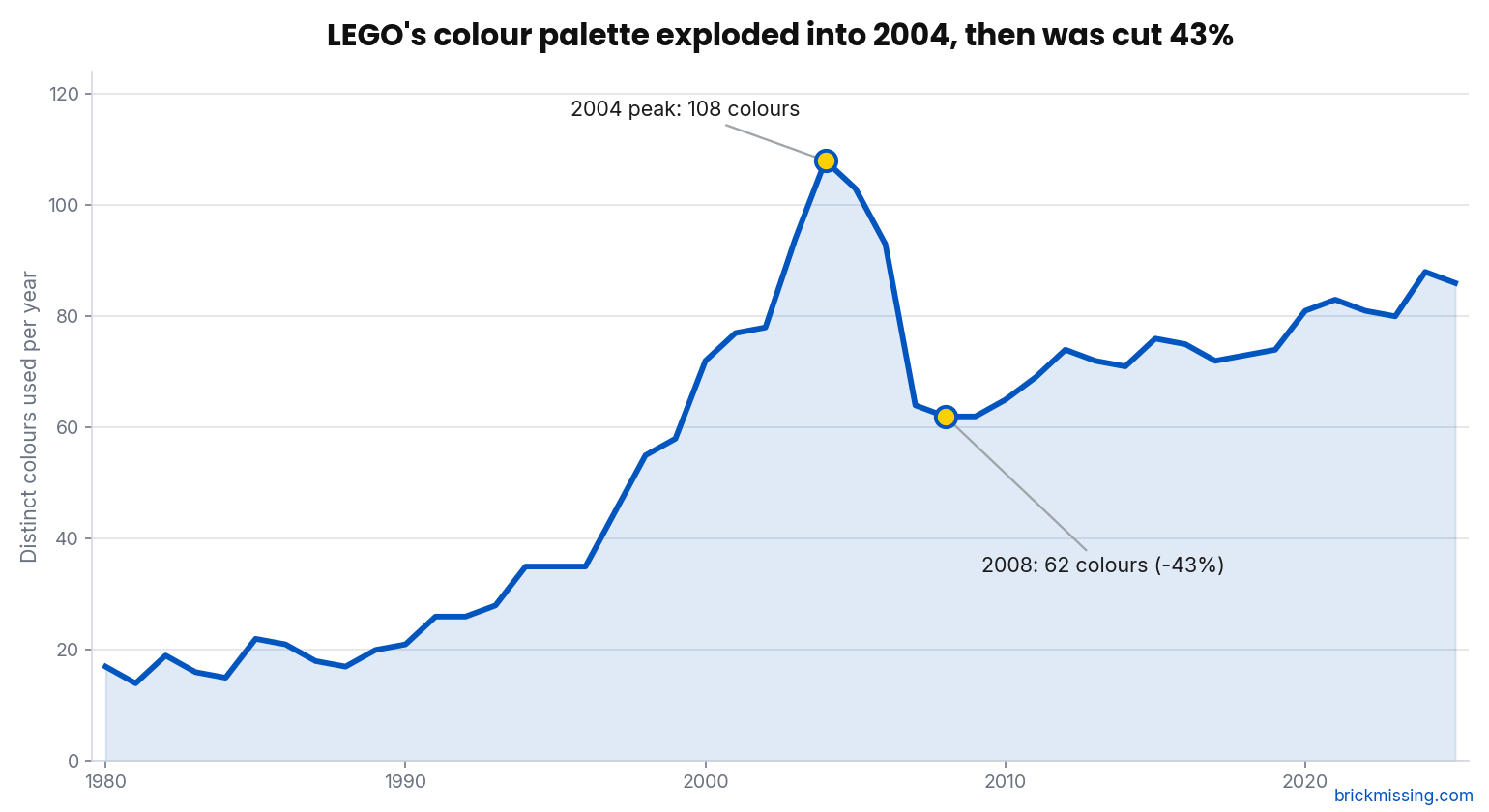
The Great Gray Change of 2004
If you have ever heard AFOLs argue about "bley", this is it. For decades LEGO's two grays were simply Light Gray and Dark Gray. In 2004 they vanished, and two new, slightly blue-tinted grays took their place. Our data captures the swap with almost violent precision.
Light Gray appeared in 201 sets in 2002 and 150 in 2003; by 2005 it was down to 6, and gone soon after. In their place, two new greys appeared almost from nothing: Light Bluish Gray went from just 21 sets in 2003 to 196 in 2004, and Dark Bluish Gray from 18 to 189 in the same year. The same happened to brown: the original Brown (721 sets) was retired by 2006 and Reddish Brown took over as LEGO's standard brown. Two decades on, the bluish greys are among the most-used colours LEGO has, and the originals are collector trivia.
| Color (sets per year) | 2002 | 2003 | 2004 | 2005 | 2006 |
|---|---|---|---|---|---|
| Light Gray (old) | 201 | 150 | 40 | 6 | 4 |
| Dark Gray (old) | 144 | 139 | 24 | 11 | 4 |
| Light Bluish Gray (new) | 2 | 21 | 196 | 194 | 190 |
| Dark Bluish Gray (new) | 0 | 18 | 189 | 195 | 212 |
The workhorses: LEGO's most-used colors
Across the whole catalog, a handful of colors do most of the work. Black appears in 15,838 sets — roughly three in every five sets LEGO has ever made. Red and White follow close behind. The remarkable part is what sits in fourth and sixth place: the two bluish grays from the 2004 change have already overtaken decades-older colors like Yellow and Orange, despite existing for only twenty years. That is how completely the Great Gray Change reshaped the palette.
| Color | Appears in |
|---|---|
| Black | 15,838 sets |
| Red | 11,508 sets |
| White | 11,297 sets |
| Light Bluish Gray | 10,758 sets |
| Yellow | 9,608 sets |
| Dark Bluish Gray | 7,970 sets |
| Tan | 5,540 sets |
| Trans-Clear | 5,224 sets |
| Reddish Brown | 4,999 sets |
| Orange | 4,162 sets |
The class of 2004: out with the old, in with the new
The 2004–2006 cull was not just a shrinking — it was a clear-out and a restock. At least 30 well-established colors, each used in ten or more sets, made their final appearance in those years. Some are genuinely missed: the original Brown and Dark Gray, but also Medium Green, Earth Orange and Light Green.
But LEGO was also adding. The years on either side of the cull introduced colors that are now staples: Light Nougat — the modern minifig skin tone — arrived in 2004 and is already in over 1,700 sets. Bright Light Orange, Bright Pink, Dark Pink, Pearl Gold and Bright Light Yellow all date from 2003–2004. The palette did not just get smaller; it got modernized.
| Retired color | Last seen | Sets |
|---|---|---|
| Dark Gray | 2006 | 1,060 |
| Brown | 2006 | 721 |
| Medium Green | 2005 | 90 |
| Earth Orange | 2005 | 76 |
| Light Green | 2005 | 55 |
| Pink (original) | 2005 | 39 |
The most colorful set ever made
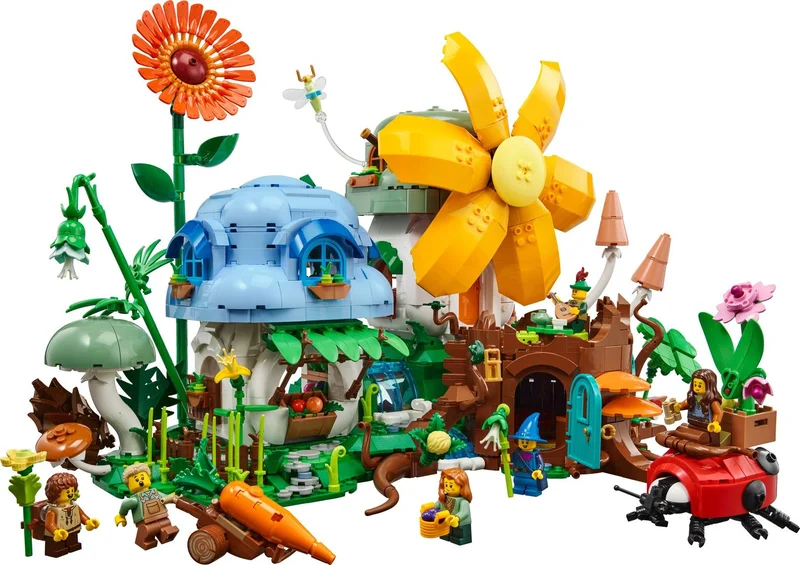
If you want the widest palette in a single box, the record holder is a recent one: the 2025 BrickLink Designer Program set Mushroom Village packs 47 distinct colors into 2,437 pieces. The runners-up come from the same fan-designed program and the modern Icons line — proof that today's leaner palette still leaves room for a riot of color when a set calls for it.
Methodology
Data: the BrickMissing catalog database (built on Rebrickable catalog data plus our own curation), snapshot June 2026 — 26,086 sets and 1,131,058 inventory records, spare parts excluded. A color counts as "used in a year" when it appears in at least one set carrying that release year.
Scope: this study covers LEGO System colors. We excluded DUPLO, the vintage 1:87 "HO" range and Modulex — all separate product lines — plus catalog placeholders such as [Unknown] and [No Color]. Colors are counted by name, merging the occasional duplicate catalog ID for the same shade. That leaves 193 distinct System colors from 1949 to 2026.
A caveat carried over from our part studies: absolute counts shift with catalog scope, and color identity follows Rebrickable's naming (LEGO's own names differ — "Light Bluish Gray" is LEGO's "Medium Stone Grey"). The trends and rankings here are stable regardless of scope. If you cite these numbers, please link back to this study so readers can check the method.
Correction (June 27, 2026): the grey chart originally counted by colour name, which merged a mislabeled catalog entry — green parts filed under "Light Bluish Gray" — into the grey totals and made the bluish greys look like they existed before 2004. It now counts by colour ID, so Light Bluish Gray and Dark Bluish Gray correctly appear only from 2003, which makes the 2004 switch even sharper. Thanks to the r/dataisbeautiful commenters who flagged it.
Lost a piece in a hard-to-find color?
When a missing part is in a color no other set uses, LEGO's Pick a Brick is often the only place to buy it — they sell individual elements in hundreds of colors.
Mushroom Village
The most color-packed set in the entire catalog: 47 distinct colors in one box. A fan-designed set from 2025 that shows just how wide LEGO's modern palette can stretch when a build calls for it.
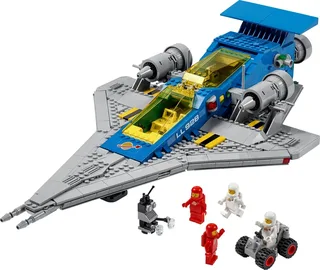
Galaxy Explorer
The Great Gray Change you can hold. The 1979 original was molded in the old Light Gray; this 2022 tribute is built in Light Bluish Gray — the same ship, two different grays, separated by the 2004 switch.
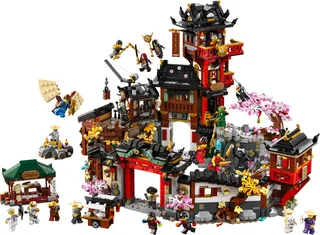
The Old Town 15th Anniversary
A modern color showcase: 41 distinct colors across 4,851 pieces, near the top of the all-time list. Proof that the post-2004 palette is leaner but far from dull.
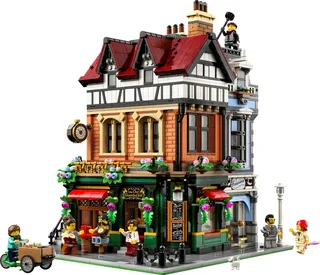
Tudor Corner
The rationalized modern palette in one model: tans, Reddish Brown and the two bluish grays doing most of the work — the exact colors that won the 2004 reshuffle.
Color is where LEGO's history hides in plain sight. The 2004 palette peak and the Great Gray Change are the fingerprints of a company reinventing itself — and they are sitting in the parts inventories of sets you may already own.
Every set page on BrickMissing lists the full parts inventory, color by color, so you can see exactly which shades a set uses and track which ones you have. And if you want to know which of those colors are hardest to replace when a piece goes missing, our companion study on LEGO repairability has the answer.