
Buying Used LEGO Sets: A Completeness Checklist
“Complete” needs a definition. Use a row-by-row checklist and a replacement-cost worksheet before paying for a secondhand set.
7 minute read · By BrickMissing
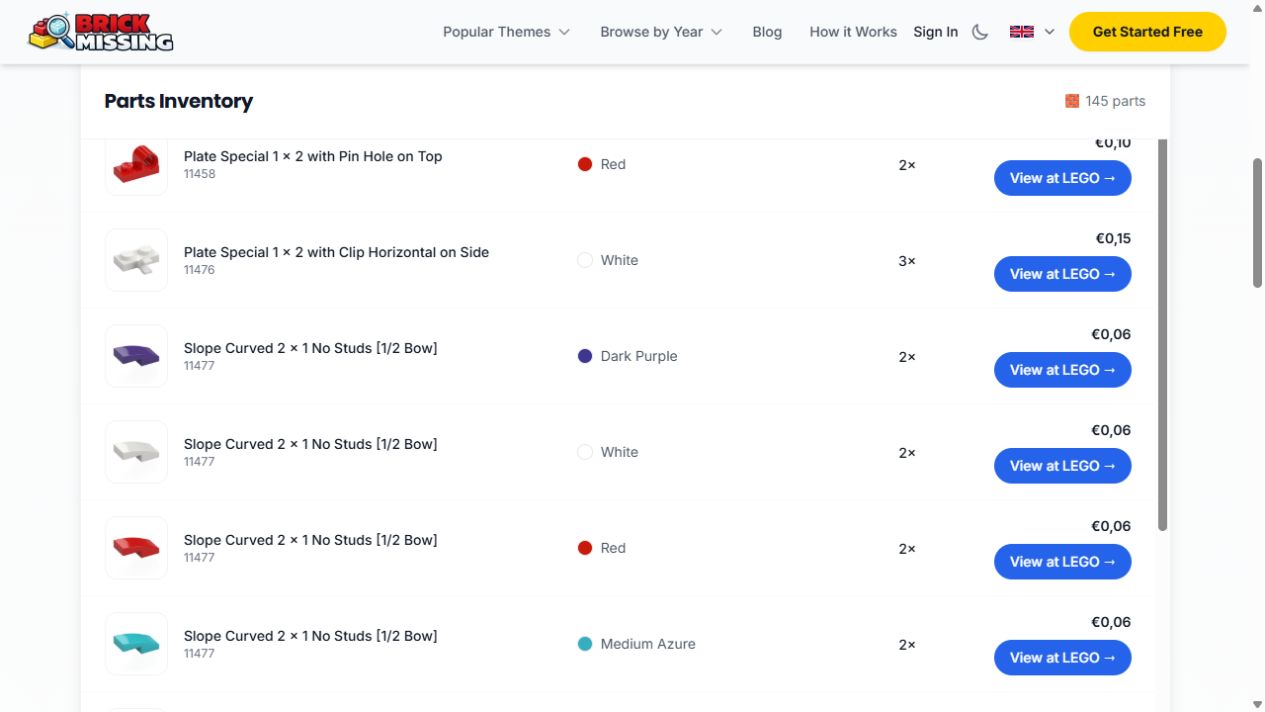
Before buying a used LEGO set, agree what the seller means by complete, compare the actual contents with a reference inventory, and list everything you cannot verify. A finished-looking model or the right total number of bricks is not a row-by-row completeness check.
This is a checking procedure, not a report of a purchase we made. The inventory example comes from our public catalog; the budget example is fictional and demonstrates how to compare offers.
1. Define what the sale includes
Separate a buildable main model from the complete advertised package. Ask explicitly about minifigures, handheld accessories, alternate-build parts, loose subassemblies, decoration, instructions and box. A missing box does not stop a build, but it can matter to the buyer.
Write the agreed scope into your notes. “Model complete, no box or instructions” is clearer than an unqualified “100% complete”. Do not count an unanswered question as a yes.
| Check | Ask or record |
|---|---|
| Identity | Exact set number and catalog variant |
| Pieces | All required part-and-color quantities, or a specific missing list |
| Figures and accessories | Exact figures, their components and accessories included |
| Decoration | Printed pieces and condition of applied stickers |
| Packaging | Instructions and box included, absent or unknown |
| Condition | Damage, discoloration, unwanted substitutions and seller photos |
2. Check pieces by row, not by total weight or count
Sort the set by shape and color, then count each required inventory row. A bag can contain the advertised total while still missing a distinctive piece and containing an unrelated substitute.
For our 31140-1 example, the public catalog has 76 required rows totaling 145 pieces. Checking only that 145 loose bricks are present leaves all 76 identities unverified.
- Confirm the set number and open its reference inventory.
- Count each exact shape-and-color combination, checking decorations separately.
- Record deficits, unusable pieces and extra pieces in different columns.
- Check figures, accessories and detached subassemblies against the promised scope.
- Mark every unchecked row as unknown until you inspect it.
- Try the worked-example counting sheet
A complete 31140-1 reference inventory with blank columns for your physical count. It is not a completed inspection.
- Download a reusable used-set checklist
Record included, missing and unknown items, condition and replacement costs for any set.
3. Inspect the parts that can change the decision
Start with the items you would find hardest to verify from the listing: decorated pieces, figures, fabric parts, transparent pieces, connectors under stress and any electronic components. Request close-ups when a distant model photo hides their condition.
Describe what you can actually observe: “crack visible in connector” is evidence; “looks genuine” from a single photo is uncertain. A LEGO logo alone does not establish that every piece in a mixed lot is authentic. If authenticity matters to the purchase, ask for clearer evidence and assess each doubtful item.
4. Ask for evidence that closes an unknown
For an assembled set, a top-down photo may show the body while hiding the underside, interior or a missing accessory. Ask for a photo of the specific area or a count of the specific inventory row you are unsure about.
For a mixed bag, a weight or a photo of the pile is not a completeness audit. If the seller cannot check the contents, evaluate the offer as an unverified lot and price that uncertainty into your decision.
| Uncertainty | Useful follow-up |
|---|---|
| A figure is not visible | A separate photo of the exact figure and accessories |
| A colored piece may be substituted | A close-up and the claimed part-and-color entry |
| Hidden structure cannot be seen | A photo of the relevant underside or assembly |
| Many rows have not been counted | A completed inventory sheet, or agreement that completeness is unverified |
5. Compare the total completion cost
Use total cost = purchase price + incoming delivery + confirmed replacement parts + replacement delivery and order charges. Include only quotes you actually checked; record unavailable quotes as unknown.
Illustration only: an incomplete offer at €25, plus €5 delivery, €6 replacements and €4 replacement delivery, totals €40. A verified complete offer at €38 delivered would cost €2 less. These are invented prices, not current offers or a valuation of 31140-1.
For several replacement sellers, add delivery and minimum-order charges for every order. A catalog-rarity score measures recorded appearances, not current stock or replacement price.
6. Decide using verified contents and remaining uncertainty
A clear missing list can make an incomplete set a sensible project. An unverified claim of completeness is weaker evidence even when the headline price is attractive. Compare both the total cost and the work you are willing to do.
Keep the seller’s description, your checks and the remaining unknowns together. You can use the same sheet to verify the contents when the parcel arrives. For motors or lights, record whether they were actually tested rather than inferring that from a photograph.
The useful outcome is a documented decision: what is included, what is missing, what remains unknown and what completion would cost. Keep those four items separate.