
Half of All LEGO Part + Color Combinations Exist in Only One Set
We analyzed 1.1 million inventory records across 26,000 LEGO sets to answer one question: if you lose a piece, can you actually replace it? The answers surprised us.
Every LEGO builder knows the feeling: the build is almost done, and one piece is missing. Whether it ever turns up depends on a question almost nobody can answer: how many other sets does that exact part, in that exact color, actually appear in?
We analyzed the full BrickMissing catalog database — 1,131,058 inventory records across 26,086 sets, from 1949 to 2026 — and scored 12,753 real building sets (30+ parts) on one metric: what share of their part+color combinations is hard to replace, meaning it appears in three sets or fewer in LEGO history. The results changed how we think about which sets are risky to buy second-hand, and which are practically indestructible.
Key findings
Of the 91,650 distinct part+color combinations LEGO has ever put in a set, 46,619 — 51% — exist in exactly one set. Another 20% appear in just two or three. Only 34% of those one-set-only combinations are printed or stickered parts; the majority are ordinary molds in colors LEGO simply never used again.
Disney sets are the riskiest mainstream theme to lose a piece from: since 2010, 17.7% of an average Disney set's part+color combinations are hard to replace — 5.7× the rate of Creator sets (3.1%). And the era of the hardest-to-repair sets was not the licensed 2020s but 2000–2004, when 15.3% of an average set's combinations were near-exclusive — twice today's level, and a visible fingerprint of the mold explosion that pushed LEGO to the brink of bankruptcy.
The immortal bricks
At the other extreme sit the parts you will never struggle to find. The black 1×2 plate has appeared in 3,472 different sets — roughly one in every seven sets LEGO has ever released. The entire top ten is basic plates and bricks in black and white, plus one surprise guest from the Technic system: the black friction pin, in 2,412 sets.
A set built mostly from these parts is effectively immortal: lose any piece, and thousands of donor sets — or any second-hand parts market — can supply it for cents.
| Part | Color | Appears in |
|---|---|---|
| Plate 1 × 2 | Black | 3,472 sets |
| Plate 2 × 4 | Black | 2,721 sets |
| Plate 2 × 2 | Black | 2,669 sets |
| Plate 1 × 4 | Black | 2,579 sets |
| Technic Friction Pin | Black | 2,412 sets |
| Brick 1 × 2 | Black | 2,226 sets |
Bigger is not riskier
You might expect the giant display sets to be the most fragile — more parts, more exotic pieces. The data says the opposite. Big Ben (4,167 parts), the Taj Mahal (5,923 parts), Assembly Square and the Land Rover Classic Defender 90 all score a perfect 0%: every single part+color combination in them appears in at least four other sets.
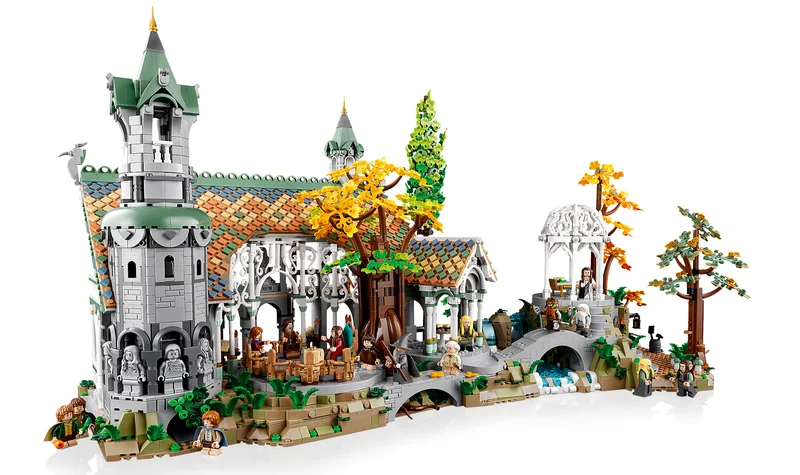
Meanwhile The Lord of the Rings: Rivendell — 6,181 parts — sits at 34%: one in three of its part+color combinations appears in three or fewer sets ever made. Lose the wrong piece and your €500 centerpiece has a permanent hole in it. The difference is design philosophy, not size: the Creator Expert and Icons architecture sets are deliberately engineered from the common palette, while licensed sets lean on rare recolors to hit their look.
The theme ranking: Disney tax, Creator safety
Averaging all sets released since 2010 per theme (building themes with 50+ sets) produces a clear hierarchy. If you are buying for a child who loses pieces — or buying second-hand where pieces are often already gone — this table is worth more than any star rating. DUPLO tops the raw list at 25.4%, though as a separate building system it mostly shares parts within its own catalog.
| Theme (since 2010) | Hard-to-replace share | Repair risk |
|---|---|---|
| Disney | 17.7% | Very high |
| Super Mario | 11.3% | High |
| Friends | 9.3% | Elevated |
| Star Wars and most licensed themes | 5–9% | Average |
| Classic | 3.4% | Low |
| Architecture | 3.2% | Low |
| Creator | 3.1% | Low |
The 2000–2004 anomaly: a corporate crisis, visible in plastic
Score every five-year era and one period jumps out. Sets released between 2000 and 2004 average 15.3% hard-to-replace combinations — the highest in LEGO history, double the modern level and almost triple the early-1990s level (5.9%).
AFOLs know why. This is the era when LEGO chased every trend with bespoke molds — Galidor, Jack Stone, early Bionicle — and nearly went bankrupt doing it. After the 2004 turnaround the company famously rationalized its part palette, and the repairability data shows exactly that: down to 10.4% in 2005–2009, and stable around 8% ever since. The corporate near-death experience of 2003 is permanently recorded in the parts inventories of the sets themselves.
| Era | Hard-to-replace share per set |
|---|---|
| 1990–1994 | 5.9% |
| 1995–1999 | 8.5% |
| 2000–2004 | 15.3% |
| 2005–2009 | 10.4% |
| 2010–2014 | 8.1% |
| 2015–2019 | 7.3% |
| 2020–2024 | 8.0% |
Follow-up findings from the community
After this study hit r/LEGO, readers asked sharper questions than we did. The answers were too good to leave buried in a comment thread, so here they are — added June 12.
How many molds, ignoring color, existed in exactly one set? Of the 50,932 distinct molds in the database, 30,304 only ever existed in one set and one color. Even after excluding prints, stickers and molded patterns, 14,851 plain molds remain that LEGO produced for a single set and never used again. The all-time champion category is Bionicle: practically every mask and weapon mold from 2001 to 2010 is a one-set, one-color part.
Was the 2000–2004 spike just Bionicle, then? No. Removing Bionicle entirely barely moves that era's average — 15.3% becomes 15.1% — so the mold explosion was company-wide. Where Bionicle does matter is 2005–2009: without it that era drops from 10.4% to 8.9%, meaning late Bionicle kept the average up while the rest of the lineup had already cleaned up its act.
How many sets score a perfect 0%? 2,923 of the 12,753 sets — about 23% — contain no hard-to-replace combinations at all. Only 88 sets score 100%, and nearly all of those are vintage single-part service packs rather than real builds.
And which part has the most one-off colors? Counting figure parts, the plain minifig left leg is the surprise winner: it exists in 56 colors, and 55 of them appeared in exactly one set. Excluding figure parts, the vintage HO-scale Volkswagen Beetle from the 1:87 era leads with 27 of its 32 colors being single-set. The everyday winner: the humble 2×3 brick has 25 colors that each lived in exactly one set.
Methodology
Data: the BrickMissing catalog database (built on Rebrickable catalog data plus our own curation), snapshot June 2026 — 26,086 sets, 91,650 distinct part+color combinations, 1,131,058 inventory records, spare parts excluded. Frequency was counted across the entire catalog; repairability was scored for the 12,753 sets with at least 30 parts and a known release year. A combination counts as "hard to replace" when it appears in three or fewer sets in all of LEGO history. Printed and stickered parts were identified by catalog name. One caveat: sets from the last ~2 years have had less time for their parts to reappear in future sets, which slightly inflates their scores; multi-set bundle packs were excluded from the set rankings.
A note on database scope, added after good questions from r/LEGO and Brickset: absolute per-part set counts differ between catalog sites, and that is expected. Our database counts every catalog entry with an inventory — including bulk tubs, education and Dacta sets, service packs and promo polybags. BrickLink splits mold variants and printed versions into separate entries, Brickset counts by element ID, and every site has inventoried a slightly different subset of sets. The black 1×2 plate illustrates the effect: BrickLink lists it in 2,716 sets, Rebrickable in 2,857, Brickset in 2,089, and our wider scope finds 3,472. Absolute numbers shift with the scope you choose; the rankings and percentages in this study are stable across all of them.
Also worth knowing: minifigures are separate entities in our data model (following Rebrickable), so minifig component parts are largely absent from the set inventories used here — under 1% of rows. Excluding everything named "Minifig" moves the headline 51% to 50.5%. Counting only plain unprinted molds, it is still 44%.
If you cite these numbers, please link to this study so readers can check the methodology. For questions or the underlying queries, contact us via the site.
Download the dataset
The data behind this study is free to download and reuse under a CC BY 4.0 license — credit BrickMissing and link to this study. Two CSV files plus documentation, exported from the live catalog (July 2026):
- Part+color frequency (CSV, ~91,500 rows, 6 MB)
Every part+color combination LEGO has ever put in a set, with the number of distinct sets it appears in, spares excluded.
- Per-set repairability scores (CSV, ~11,900 rows, 700 KB)
Every real building set (30+ parts, 15+ distinct combinations) with its share of hard-to-replace combinations.
- Dataset documentation (README)
Column definitions, methodology and license.
- Archived on Zenodo (DOI 10.5281/zenodo.21610502)
Citable, permanently archived deposit. This DOI always resolves to the latest snapshot.
The Lord of the Rings: Rivendell
The most extreme mainstream example in our data: 34% of Rivendell's part+color combinations appear in three or fewer sets ever made. A masterpiece — but treat the box like a vault, because the elven color palette has almost no donor sets.
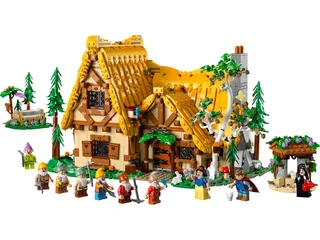
Snow White and the Seven Dwarfs' Cottage
Disney in a nutshell: 33% of its combinations are near-exclusive recolors. It is the pattern across the whole theme — the highest repair risk of any mainstream building theme since 2010.
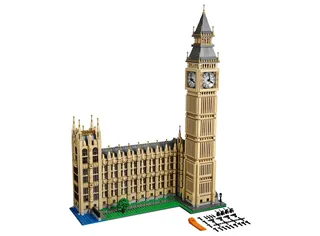
Big Ben
The counter-example: 4,167 parts and a 0% hard-to-replace score. Every part+color combination in Big Ben appears in at least four other sets. You could lose a handful of pieces and rebuild it from the second-hand market for pocket change.
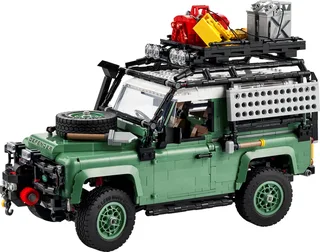
Land Rover Classic Defender 90
Modern proof that licensed does not have to mean fragile: the Defender hits its iconic look entirely with parts that exist in at least four other sets. A 0% score and the most repair-friendly way to put a car on your shelf.
The takeaway: repairability is a design choice, and it varies far more between sets than most buyers realize. Before you buy a set second-hand — or hand a 6,000-piece set to a household with small children and a vacuum cleaner — it pays to know which parts you can replace and which you cannot.
Every set page on BrickMissing lists the complete parts inventory, so you can check exactly which pieces a set contains and track which ones you own. If a piece does go missing, you will know precisely what to hunt for.